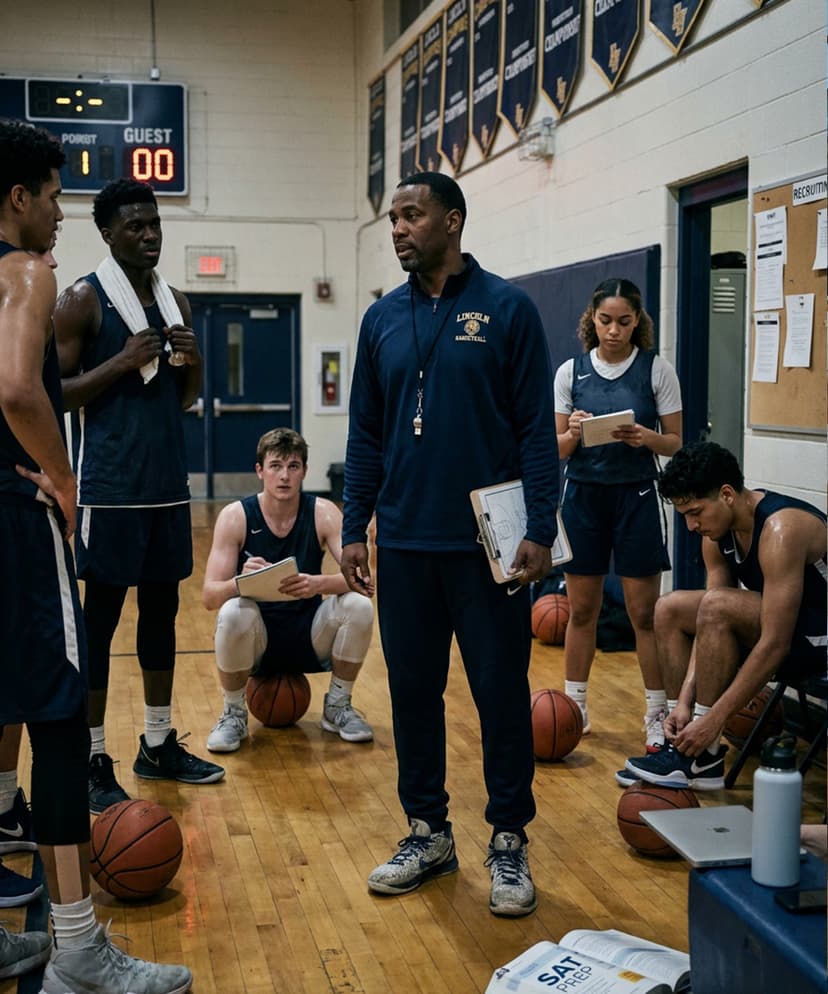
Every recruiting story starts the same way: a coach sees something on film — speed, a swing, a stat line — and leans in. That moment is real, and it matters. But it's only the first half of the story.
Talent gets you noticed. Academics get you signed. Coaches fall in love with the highlight reel, but they sign athletes they're confident can actually enroll, qualify, and stay on the field. The grades aren't a side detail to the recruiting process — they're the part that turns interest into an offer.
What coaches actually check (beyond the film)
Once a coach is genuinely interested, the conversation quietly shifts to the question every recruiting coordinator has to answer before they spend a scholarship: Can this athlete get in, and will they be eligible to play? Here's what they're really looking at.
Your core GPA — not your report-card GPA
Coaches at NCAA programs care about your core-course GPA: the grades in your NCAA-approved English, math, science, and social science classes. That number, not the overall GPA on your report card, is what determines eligibility. A coach who's recruited for any length of time knows the difference and will ask about it directly — or pull it from your transcript themselves.
Eligibility status
For Division I and II prospects, coaches want to know you're registered with the NCAA Eligibility Center and on track to be certified. An athlete who hasn't started that process — or who's missing required core courses — is a question mark, and question marks make coaches nervous when scholarships are on the line.
Test scores
Your SAT or ACT score is no longer part of NCAA eligibility (the requirement was permanently dropped in 2023), but it still matters for getting admitted to the university itself and for academic scholarship money. Even at test-optional schools, a solid score removes doubt and gives the coach one less thing to worry about.
Your transcript trend
Coaches don't just look at the final number — they look at the shape of your transcript. A student who started shaky as a freshman but climbed steadily tells a story of growth and coachability. A strong student whose grades suddenly dipped raises a flag. The trend line says something about who you'll be once you're juggling practice, travel, and college coursework.
Why the "academically safe" recruit is easier to offer
Put yourself in the coach's seat. They have a limited number of scholarships and roster spots, and every one is a bet. An athlete who clearly clears the Eligibility Center, gets admitted without drama, and has a transcript that suggests they'll stay academically eligible is a low-risk bet. An athlete with the same talent but a murky academic picture is a gamble — one that could cost the coach a scholarship, a roster spot, and the recruiting class they built around that player.
Coaches won't waste an offer on someone they're not confident can qualify. So between two similar athletes, the one who's academically safe is simply easier to say yes to. You're not just competing on the field — you're competing to be the recruit who's the least amount of work and the least amount of worry.
How to present your academics to coaches
Don't make a coach dig for this information. Hand it to them, clearly, in one place. A clean athletic resume does exactly that and signals you're serious and organized. It should include:
- GPA — and ideally your core GPA, not just your overall
- Test scores — SAT/ACT, if you've taken them
- Graduation year and current grade
- Film link — your highlight reel, easy to click
- Measurables — height, weight, and the key numbers for your sport (40 time, vertical, exit velocity, etc.)
- Contact info for you and your parent, plus your coach
When your academics are right there next to your film, you're answering the eligibility question before the coach even has to ask it. That's exactly the impression you want to make.
Concrete steps to become a low-risk recruit
- Register with the NCAA Eligibility Center early — ideally by your sophomore or junior year, so nothing is left to the last minute.
- Know your core GPA. Recalculate using only your NCAA-approved core courses so you and the coach are working from the real number.
- Protect your transcript trend. Finish the bulk of your core courses before senior year and keep grades steady — coaches notice a strong upward line.
- Take the SAT or ACT with time to retake. A better score is leverage for admissions and academic scholarship money, even though the NCAA no longer requires it.
- Build a clean athletic resume with GPA, test scores, film, and measurables in one place, ready to send the moment a coach asks.
- Be honest about where you stand. Coaches respect a recruit who knows their numbers and has a plan over one who's vague or hoping no one looks closely.
None of this replaces the talent — it protects it. The grades are what let a coach act on everything they already love about your game.
One caveat
Academic requirements vary by division, and each school sets its own admissions standards on top of the NCAA's. Specific numbers and core-course lists are updated periodically, so treat this as a clear map of what coaches are checking — not a final ruling. Confirm the current requirements and your school's approved core courses through the official NCAA Eligibility Center before making decisions.
Common questions
Do college coaches really check grades, or just film?+
Both. Film gets you on a coach's radar, but before they make an offer they check your core GPA, eligibility status, test scores, and transcript trend to be sure you can enroll and stay eligible. Talent gets you noticed; academics get you signed.
What academic information should I send a coach?+
A clean athletic resume with your GPA (ideally your core GPA), SAT/ACT scores, graduation year, a film link, your measurables, and contact info. Putting it all in one place answers the eligibility question before the coach has to ask.
Why does being 'academically safe' make a coach more likely to offer?+
A scholarship is a bet. An athlete who clearly clears the Eligibility Center, gets admitted, and is likely to stay eligible is a low-risk bet. Between two similar athletes, the academically safe one is simply easier to say yes to.
When should I register with the NCAA Eligibility Center?+
Early — ideally by your sophomore or junior year. Coaches want to know you're registered and on track to be certified, and starting early keeps nothing for the last minute.