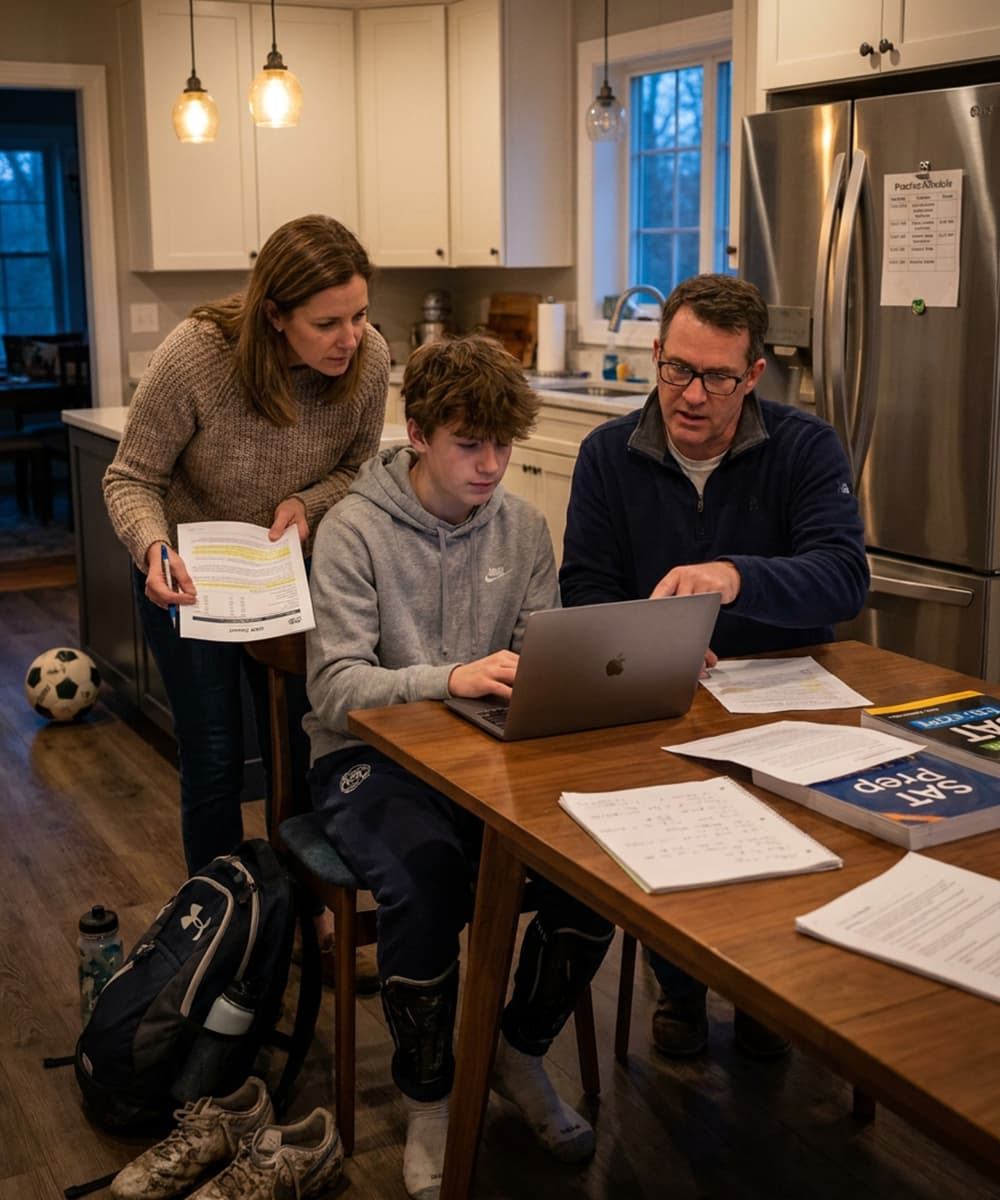
Roughly two million American students are homeschooled, and a meaningful slice of them are serious athletes. The NCAA has a defined path for them — same academic standards, different paperwork — and families who learn the documentation rules early sail through certification while others scramble senior year.
The standards don't change
A homeschooled athlete needs the same things every athlete needs: the 16 core courses in the right subject distribution and a qualifying core GPA (2.3 for D1, 2.2 for D2). There is no separate homeschool standard — only a different way of proving it.
What the Eligibility Center asks homeschoolers for
- A transcript prepared and signed by the home school administrator (typically the teaching parent) — course titles, grades, credits, grading scale, and dates.
- Evidence of compliance with your state's homeschool law — states regulate homeschooling differently, and the NCAA wants proof yours was followed.
- Course information — be ready to describe what was studied and what materials were used, especially for core subjects.
The mixed-credit trap
Most homeschool transcripts today are hybrids: parent-taught courses plus co-op classes, online providers, and dual-enrollment at community college. Each source has its own NCAA status. Online course providers in particular vary — some are NCAA-approved, some are explicitly not. Verify every outside provider before you rely on the credit, not after.
Grading honestly helps you
Straight-A homeschool transcripts draw scrutiny. A grading scale that's documented, consistent, and defensible — with outside validation points like dual-enrollment grades or test scores — makes certification smoother and makes college coaches more comfortable.
Get specific answers for your situation
Homeschool cases are exactly what our Eligibility Co-pilot is for — ask about your specific course mix, your state, your providers, and get answers grounded in the current rulebook. Then run the full evaluation to see the course-by-course picture the NCAA will see.
Common questions
Can homeschooled athletes play NCAA Division I?+
Yes — homeschooled athletes qualify for D1 and D2 every year. They meet the same core-course and GPA standards as traditional students, but with additional documentation requirements handled through the Eligibility Center.
Who signs a homeschooler's transcript for the NCAA?+
The home school administrator — usually the teaching parent — prepares and signs the transcript, including course titles, grades, credit values, and grading scale. The Eligibility Center provides specific guidance for home school documentation.
Do homeschool co-op or online classes count as core courses?+
They can. Courses from co-ops, online providers, and community colleges each have their own approval status — some online programs are on NCAA-approved lists, others aren't. Verify each provider before relying on the credit.